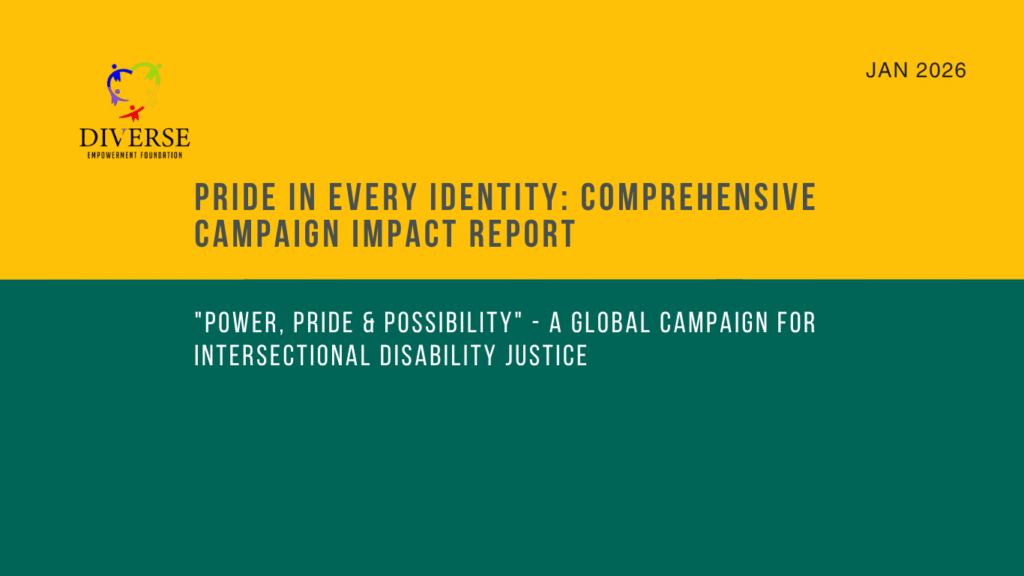
Pride in Every Identity: A Global Campaign for Disability Justice
In July 2025, the Diverse Empowerment Foundation (DEF) led a global campaign that brought together disabled people, activists, organizations, and communities across continents under one shared commitment.
That disability justice must be intersectional, visible, and led by those most often pushed to the margins.
Pride in Every Identity was not designed as a traditional awareness campaign. It was built as a space for connection, visibility, and collective power, centering disabled people who are also queer, trans, feminist, and part of other marginalized communities.
The sections that follow outline how this campaign was structured, what it made possible, and why it matters beyond the moment in which it took place.
What Made This Campaign Different
Many campaigns speak about inclusion. Few are structured to practice it.
From the beginning, this campaign was designed to prioritize accessibility as a foundation rather than an afterthought, to center leadership from the Global South, to create space for lived experience to shape the narrative, and to move beyond visibility into sustained engagement.
This meant working with limited resources, making intentional decisions about where to invest, and trusting community-led momentum over top-down coordination.
A Moment of Rapid, Collective Growth
Within 48 hours, the campaign grew from a small starting group to a global network of participants and partners.
- 250+ participants across 21 countries
- 100+ partner organizations and collectives
- 90% of leadership from the Global South
- 91% participant retention and continued engagement
- 21% accessibility accommodation request rate
What emerged was not just participation, but movement.
Working Within Constraint
This campaign was delivered with a $1,000 accessibility-focused grant.
That constraint shaped how decisions were made, what was prioritized, and how the work was coordinated.
Rather than limiting the campaign, it clarified what mattered: investing in accessibility where it would have real impact, relying on strategic volunteer coordination, and building partnerships based on shared commitment rather than funding.
The result was a campaign that reached beyond what its resources might have suggested was possible.
More Than Participation
What sustained this campaign was not just visibility, but the way people chose to remain connected.
Participants did not engage and then leave. They stayed, contributed, and shaped the direction of the work.
The campaign created space for storytelling and lived experience, opened opportunities for organizations to collaborate across regions, invited new voices into disability justice work, and built a sense of shared ownership that extended beyond the campaign timeline.
This is what allowed the work to continue beyond the moment in which it began.
Accessibility as Practice
One of the clearest indicators of the campaign’s impact was the level of engagement with accessibility.
A 21% accommodation request rate signals something important: people trusted the space enough to ask for what they needed.
This is significantly higher than typical campaigns, where accessibility is often offered but rarely utilized at scale.
Here, accessibility was not treated as an add-on. It was part of how the campaign was designed, communicated, and experienced.
The result was a campaign that reached beyond what its resources might have suggested was possible.
What This Campaign Made Visible
The campaign surfaced a gap that has long existed across movements.
Disability is often left out of LGBTQ+ organizing.
Gender and sexuality are often left out of disability work.
This campaign did not try to resolve that tension neatly. It made it visible and created space for a collective address.
It showed that intersectional organizing is possible at scale, that leadership from the Global South is not only necessary but effective, and that people are ready to engage when they are genuinely included.
More than that, it showed that when those conditions are present, participation deepens into something more sustained, more relational, and more transformative.
What This Makes Possible
This campaign was not an endpoint. It opened a pathway.
For those who encountered this work, whether as participants, partners, or observers, it offers a tangible example of what becomes possible when accessibility, intersectionality, and community leadership are taken seriously.
It points toward a way of organizing that is slower, more intentional, and more accountable to the people it is meant to serve.
The next phase of this work is not about replicating the campaign exactly as it was, but about deepening its approach, expanding its reach, and continuing to build spaces where people are not just included, but able to shape what comes next.
This campaign was not an endpoint. It opened a pathway.
For those who encountered this work, whether as participants, partners, or observers, it offers a tangible example of what becomes possible when accessibility, intersectionality, and community leadership are taken seriously.
It points toward a way of organizing that is slower, more intentional, and more accountable to the people it is meant to serve.
The next phase of this work is not about replicating the campaign exactly as it was, but about deepening its approach, expanding its reach, and continuing to build spaces where people are not just included, but able to shape what comes next.
Read the Full Campaign Report
The full report provides a detailed look at the campaign’s design, implementation, lessons learned, and future direction.
Take the Next Step
If this work resonates with you, we invite you to stay connected to what is being built.
You might be part of this as an organization rethinking how inclusion is practiced, as a funder seeking to support work that is community-led and intersectional, or as someone committed to building spaces where people can show up fully as themselves.
This work grows through collaboration, through resourcing, and through shared commitment.
If you would like to explore partnership or support this next phase, we would welcome that conversation.
what comes next.
Recent Posts
Ways To Give
Whatever form your support takes, it directly empowers Diverse persons with and without disabilities to build the futures they deserve.