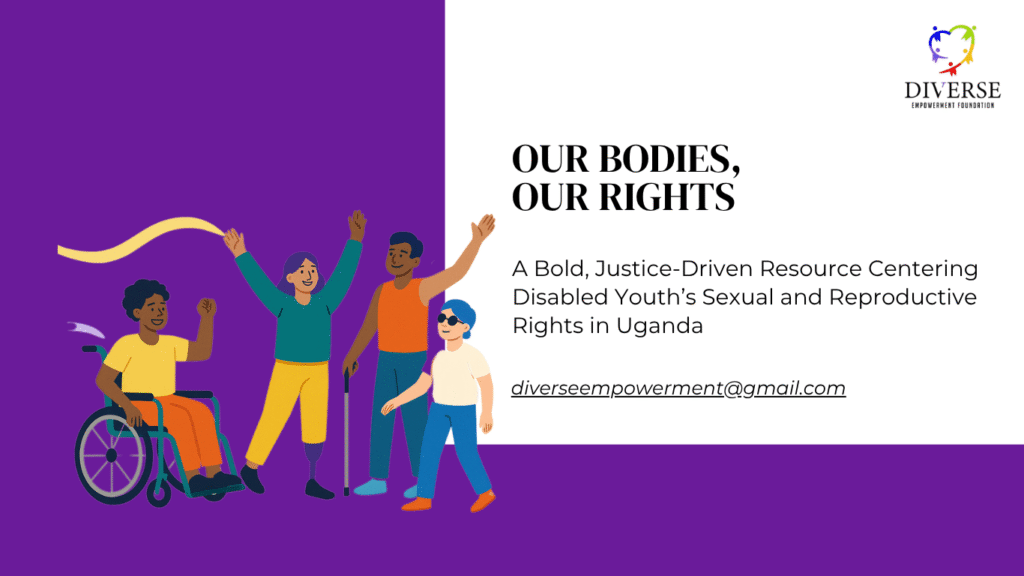
Our Bodies, Our Rights: Centering Disabled People in SRHR
Across many communities, conversations about sexual and reproductive health and rights (SRHR) continue to exclude disabled people.
Disabled people are often excluded not only from services, but from the conversations that shape them, from the information that informs decisions, and from the systems meant to support their health and autonomy.
Our Bodies, Our Rights, authored by Gracie Brendah Nanyunja, Co-Founder of the Diverse Empowerment Foundation (DEF), was developed to challenge that exclusion and create a space where disabled people, particularly young people, are centered in discussions about their bodies, choices, and rights.
This is not only about access to information. It is about dignity, autonomy, and the right to exist fully within systems that have often denied that possibility.
The Context Behind This Resource
Disabled people are often spoken about in ways that erase their humanity.
They are assumed to be asexual, incapable of making decisions about their bodies, or unworthy of relationships, pleasure, and family life. These assumptions are not neutral. They shape how systems are designed, how services are delivered, and whether people can access care at all.
As a result, many disabled people are left navigating:
- limited or inaccessible SRHR information
- healthcare systems that are not designed for them
- stigma that restricts autonomy and choice
This resource exists to confront those realities directly.
What This Resource Holds
Our Bodies, Our Rights brings together lived experience, practical knowledge, and a rights-based framework to support more inclusive and responsive SRHR spaces.
It includes:
- clear explanations of key concepts such as consent, contraception, and sexual health
- guidance on navigating SRHR systems that may not be accessible
- community-informed insights drawn from real experiences shared by disabled people
- a focus on autonomy, choice, and dignity
The content is designed to be understandable, adaptable, and grounded in real life.
A Clear Position
This resource is grounded in a simple but often denied truth:
Disabled people are whole human beings.
We love, desire, question, explore, and make decisions about our bodies and our futures.
SRHR is not a privilege. It is a right. It is about consent, bodily autonomy, access to information, and the freedom to make choices without coercion, stigma, or exclusion.
Who This Resource Is For
This resource was created with multiple audiences in mind:
Disabled people, particularly young people, deserve access to information that reflects their realities and supports their choices.
Healthcare providers and educators play a critical role in shaping how SRHR services are experienced and must be equipped to provide inclusive and respectful care.
Organizations and advocates working to strengthen SRHR programming who need tools to integrate disability inclusion into their work better.
What Needs to Change, and What Becomes Possible
Inclusion in SRHR cannot remain at the level of intention. It must be built into how systems function.
This means:
- information that is available in accessible and diverse formats
- healthcare spaces that are welcoming and responsive
- providers who respect autonomy, consent, and decision-making
- systems that recognize disabled people as participants, not exceptions
When these shifts are made, the impact is immediate.
People are able to understand their rights, make informed decisions, access care with dignity, and participate fully in conversations about their bodies and lives.
This is not only about improving services. It is about restoring agency, and ensuring that disabled people are able to define their own lives — rather than having those decisions shaped by limitation, assumption, or exclusion.
Read the Full Resource
The full guide offers detailed insights, explanations, and practical support for navigating SRHR in more inclusive ways.
Take the Next Step
If you are working in healthcare, education, advocacy, or community spaces, this resource offers a starting point for building more inclusive and responsive SRHR systems.
We invite you to:
- Use this resource within your work and share it widely
- reflect on how your systems include or exclude disabled people
- engage with DEF to strengthen disability-inclusive SRHR approaches
If you would like to collaborate or learn more, we would welcome that conversation.
Recent Posts
Ways To Give
Whatever form your support takes, it directly empowers Diverse persons with and without disabilities to build the futures they deserve.