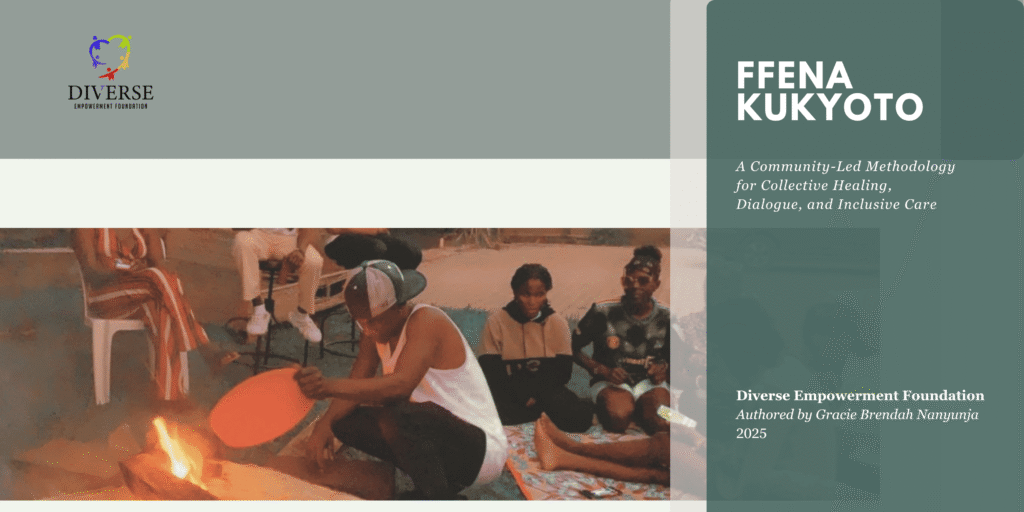
Ffena Kukyoto: A Community-Led Methodology for Collective Healing, Dialogue, and Inclusive Care
Diverse Empowerment Foundation is pleased to share Ffena Kukyoto, a community-led methodology developed through practice, listening, gathering, and responding to what communities said they needed.
Meaning “All of Us by the Bonfire,” Ffena Kukyoto draws from the cultural practice of gathering around a fire, not simply as a physical setting, but as a way of being together. It creates space for people to speak, listen, reflect, rest, learn from one another, and experience care without being required to explain themselves or perform strength.
Ffena Kukyoto was not created first as a framework and then taken into community. It happened the other way around.
The practice came first.
From a space into a methodology
Through the work of Diverse Empowerment Foundation (DEF) in Uganda, we repeatedly encountered people navigating isolation, stigma, violence, mental health challenges, exclusion, and the everyday realities of living at the intersections of disability, gender, sexuality, and economic vulnerability.
Formal services remained important, but they did not always answer another, equally important need: somewhere to simply be.
Community members needed spaces where they could arrive after a difficult day, sit with others, speak if they wanted to, remain quiet if they did not, ask difficult questions without judgment, and receive support without immediately being treated as a problem that needed to be solved.
Ffena Kukyoto emerged from that need.
What began as small, intentional bonfire gatherings gradually developed into a broader ecosystem of care involving healing circles, community dialogue, peer support, shared learning, counseling and referral pathways, and relationships that continue beyond an individual gathering.
Over time, repeated practice also revealed something important: what appeared informal was, in fact, intentionally structured.
The ways people welcomed one another, listened, sought consent, responded to difficult emotions, allowed silence, shared knowledge, and collectively held the space had become a recognizable methodology.
We chose to document it so that this knowledge would not remain invisible.
Care as something we create together
At the heart of Ffena Kukyoto is a different understanding of care.
Care is not simply something delivered by a professional to a recipient. It can also be something created collectively through presence, attention, relationships, and the ways people respond to one another.
The methodology is grounded in principles that emerged through practice, including non-judgment, voluntary participation, attentive listening, consent-based interaction, lived experience as knowledge, collective responsibility for care, and emotional holding.
These principles affect not only what happens during a gathering, but how the space feels.
Participants are not required to speak. Silence and observation are valid forms of participation. People are not assumed to owe others physical or emotional access. Even gestures intended as comfort are guided by consent. Lived experience is treated as a legitimate source of knowledge, rather than something secondary to professional expertise.
When someone shares something painful, the first response does not have to be advice or an attempt to fix what has happened.
Sometimes care begins with staying.
Ffena Kukyoto describes this as emotional holding, being present with someone’s experience without immediately interpreting it, redirecting it, or pushing the person toward a particular outcome.
Professional care remains available. Trained counselors can provide individual support when needed. But professional support exists within, rather than replacing, the wider ecology of community care.
Accessibility is part of the methodology
Accessibility in Ffena Kukyoto is not treated as an adjustment made after a space has already been designed.
It begins with the environment.
The methodology considers how people enter and move through a space, where they can sit or rest, whether wheelchair users can participate without having to request special arrangements, how people communicate, what language feels natural, and whether different ways of participating are respected.
A participant can speak, listen, sit quietly, take time before joining a conversation, or step away when needed.
This flexibility matters because inclusion is not only about inviting people into room. It is also about creating conditions in which people can participate without having to negotiate for their dignity.
A methodology shaped by lived experience
Ffena Kukyoto also challenges conventional ideas about who holds knowledge.
Participants bring knowledge from survival, relationships, disability, sexuality, identity, mental health, independent living, community, and everyday life. People share what has worked, what has not, what they are still trying to understand, and what they have learned from navigating their own circumstances.
Knowledge is therefore co-created rather than simply delivered.
This has allowed conversations to become places of both care and learning, while keeping participants’ realities at the centre.
Across implementation cycles, DEF’s documentation has identified recurring changes, including stronger participant engagement, increased confidence in speaking and self-expression, continued demand for the spaces, stronger relationships and belonging, greater access to information, and increased uptake of counseling and support services.
These are not presented as clinical outcomes. They are understood as lived and relational changes that emerge over time.
Adaptation without losing the heart of the practice
Documenting Ffena Kukyoto does not mean turning it into a fixed manual.
The methodology is rooted in a particular cultural, social, and community context. The bonfire, for example, is both a physical and symbolic centre of the original practice. In another community, a different cultural or symbolic anchor may make more sense.
Language may change. Facilitation approaches may change. Accessibility needs will differ. Topics and forms of expression should respond to local realities.
The purpose is not exact replication.
It is understanding.
What should remain are the conditions that make the space what it is: safety without judgment, participation without pressure, care without hierarchy, and connection without expectation.
Ffena Kukyoto therefore invites practitioners and communities to understand the principles, identify what must be protected, and then adapt the form with care.
This is why we describe it as a living methodology.
As it travels into different contexts, it can continue to learn, respond, and evolve through the communities that engage with it.
Documenting what communities already know
Ffena Kukyoto also carries a wider message about knowledge.
Community-led practices are often created long before they are named. People develop ways of caring for one another, creating safety, sharing knowledge, surviving difficult conditions, and building belonging. Yet much of this knowledge remains undocumented and can therefore become invisible within formal systems.
Documenting Ffena Kukyoto is our contribution to making that knowledge visible.
It is an acknowledgement that practice generates knowledge.
That lived experience generates knowledge.
And that communities are not only recipients of models and interventions developed elsewhere. They are also designers, thinkers, teachers, and producers of methodologies that others can learn from.
We share Ffena Kukyoto in that spirit: not as a finished answer, but as an invitation to learn from a practice that continues to grow.
Ffena Kukyoto: A Community-Led Methodology for Collective Healing, Dialogue, and Inclusive Care was developed by the Diverse Empowerment Foundation and authored by Gracie Brendah Nanyunja and Ruby Loretta.
Read the full methodology
Explore the complete resource to learn about the origins and ethical foundations of Ffena Kukyoto, the structure of a gathering, safeguarding and facilitator care, observed outcomes, partnerships and co-building, and guidance for thoughtful adaptation in different contexts.